
Understanding the significance of operational scalability is critical for any organisation aiming for growth. As markets evolve, organisations must adapt their operational frameworks to handle increasing demands and complexities. This is where the Operational Scalability Methodology™ (OSM) plays an essential role in ensuring sustainability and scalability.
Growth creates operational complexity
As organisations expand, customers increase, product portfolios broaden, teams grow and decision-making becomes more distributed. What once worked through direct oversight, personal knowledge and informal communication becomes increasingly difficult to manage.
For example, a company that relied heavily on a few key personnel to manage operations may face challenges as it expands. When those individuals are unavailable, critical knowledge may be lost, leading to inefficiencies. OSM addresses these risks by promoting knowledge distribution and process documentation across teams.
Many organisations assume that growth problems can be solved by working harder, hiring more people or investing in new technology. In reality, sustainable growth depends on something far more fundamental: the ability of the organisation to scale its operations without losing control, consistency or performance.
The Operational Scalability Methodology™ (OSM) was developed to assess an organisation’s ability to scale and identify the operational constraints preventing scalable growth.
The methodology not only assesses current capabilities but also benchmarks against industry standards. This comparison helps organisations identify specific areas where they can enhance their operational frameworks to achieve greater scalability.
What is OSM?
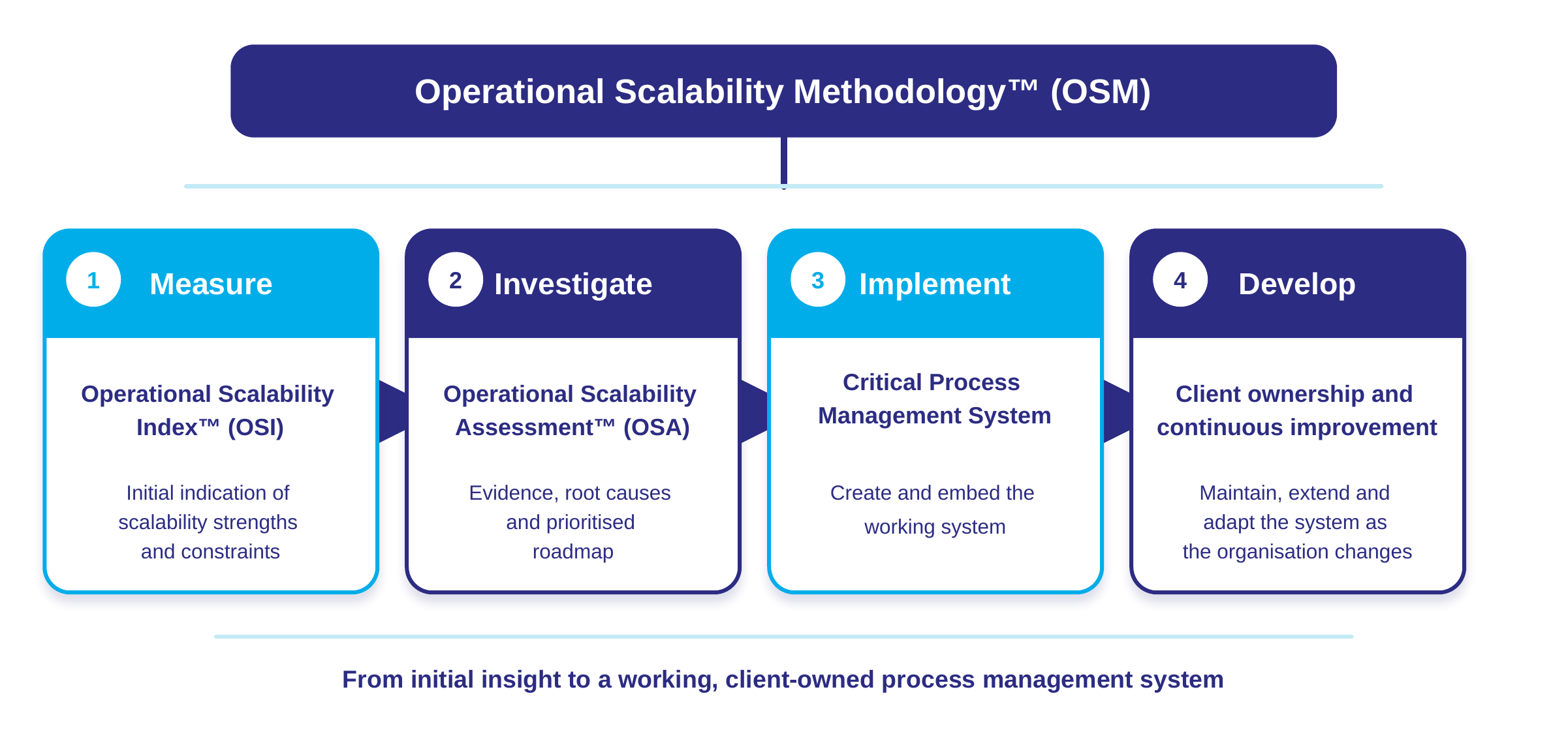
The Operational Scalability Methodology™ (OSM) is E-Squared’s four-stage method for identifying and resolving the operational constraints that prevent organisations from scaling successfully.
At its core, OSM is about creating a resilient organisation that can thrive in fluctuating market conditions. This involves a multifaceted approach, integrating technological advancements, process improvements, and cultural shifts.
To illustrate, consider a retail organisation that has seen rapid growth. Without OSM, they may struggle to maintain customer satisfaction due to stock shortages or delayed shipments. By implementing OSM, the organisation can streamline its supply chain processes, ensuring efficient inventory management and timely deliveries.
It provides a structured route from initial measurement and evidence-based operational scalability assessment through to implementation and continuing development.
1. Operational Scalability Index™ (OSI)
The Operational Scalability Index™ (OSI) is an innovative self-assessment tool that provides tangible metrics for organisations aiming to evaluate their scalability. By using OSI, companies can pinpoint their strengths and uncover potential weaknesses that hinder growth. You can access this by clicking ‘Discover Your Operational Scalability Score’ below.
2. Operational Scalability Assessment™ (OSA)
This is an evidence-based investigation that we conduct on-site at your organisation. It expands on the OSI to identify the underlying causes of limited visibility, weak operational control and scalability constraints. The outcome is a set of prioritised operational issues, validated constraints and underlying causes; areas requiring intervention; a practical implementation roadmap and a defined scope for any Critical Process Management System work that may be required.
3. Critical Process Management System Implementation
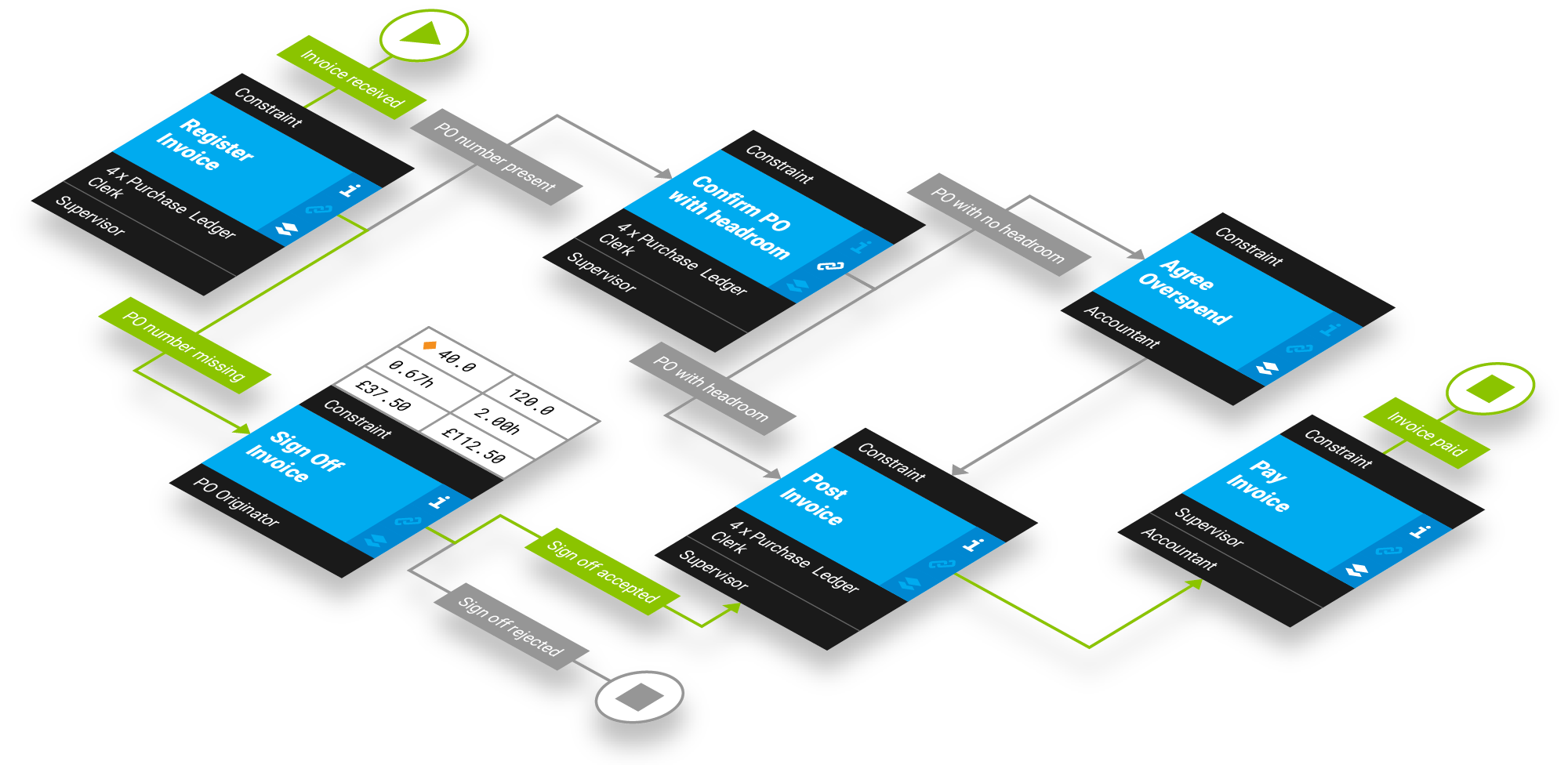
The OSA identifies the operational constraints preventing the organisation from achieving its objectives. E-Squared then works with the people who lead, perform and understand the critical work to design and implement a practical Critical Process Management System.
This establishes clear processes, responsibilities, controls and management information, enabling teams to address the identified constraints, manage performance and sustain improvement.
4. Continuing Development
The organisation maintains, expands and adapts its process management system as its operations, priorities and risks change.
What we assess
The Six Dimensions of Operational Scalability
OSM assesses the operational foundations that determine whether a growing organisation can increase scale without losing visibility, control or performance.
The assessment examines six interconnected dimensions. Together they provide a structured view of the organisation’s operational scalability and reveal where weaknesses in structure, knowledge, processes or control are creating constraints to growth.

Organisational Structure
For example, a manufacturing firm may leverage OSM to assess its production line efficiency. By refining operational processes and enhancing visibility, the firm can better manage resources, reduce waste, and ultimately boost profitability.
The degree to which the organisation has the operational structure needed to support scalable growth.

Organisational Knowledge
Moreover, the methodology encourages organisations to evaluate their readiness for automation. In today’s digital age, embracing technology can lead to significant operational improvements. OSM guides organisations in identifying processes that can be automated, thus freeing up human resources for more strategic tasks.
The extent to which critical knowledge is embedded within the organisation rather than residing with individuals.

Automation Readiness
This readiness for automation is crucial as industries continue to evolve. By fostering a culture that embraces technology, organisations can enhance their scalability and adapt to future challenges more effectively.
The degree to which operational processes are sufficiently defined and controlled to support automation and technology investment.

Process Visibility
Effective process visibility ensures that management can make informed decisions based on real-time data. This responsiveness is imperative in today’s fast-paced business environment, where delays can lead to missed opportunities.
The ability of management to understand how work flows through the organisation and where constraints exist.

Operational Resilience
Furthermore, operational resilience allows organisations to become less reliant on individual efforts. By embedding processes and controls, companies can maintain performance levels even during challenging times.
The organisation’s ability to perform consistently without dependence on exceptional individual effort.

Process Consistency
For example, during a crisis, a resilient organisation can quickly pivot its operations to ensure continuity. This adaptability is a key component of operational scalability, allowing businesses to thrive regardless of external pressures.
The extent to which operational processes are defined, adopted and applied consistently across the organisation.
The Operational Scalability Index (OSI)
The Operational Scalability Index (OSI) is not just a tool; it serves as a beacon for organisations striving to enhance their scalability. By understanding its implications, organisations can make strategic decisions that foster sustainable growth.
The metric of scalability
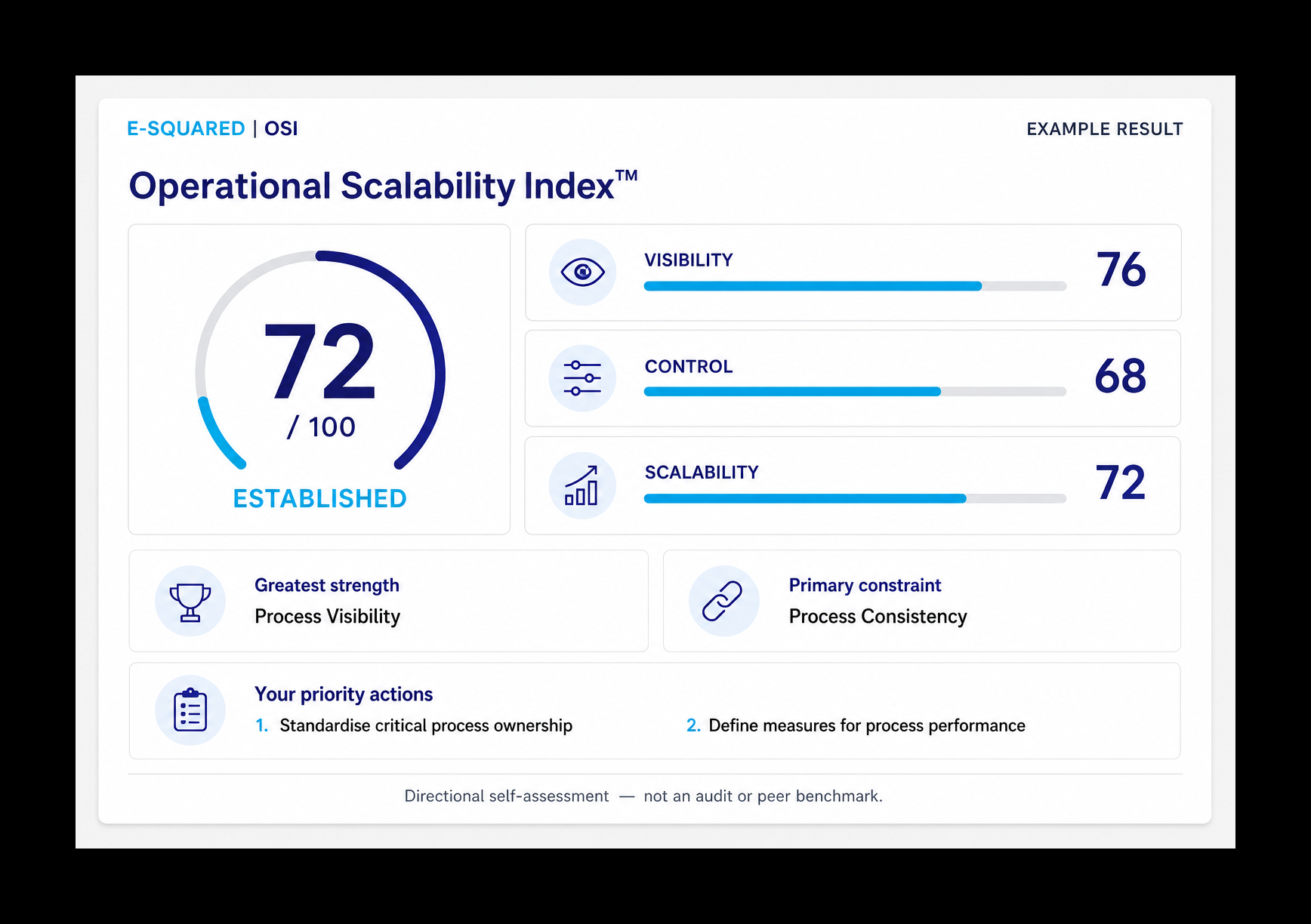
The Operational Scalability Index™ (OSI) provides a quantitative measure of an organisation’s current scalability position.
It highlights strengths and operational constraints across the six dimensions, providing a consistent basis for identifying priorities and tracking improvement over time.
Benefits
✓ Objective measurement
✓ Identification of scalability constraints
✓ Prioritised improvement opportunities
✓ Progress tracking over time
✓ Better-informed growth decisions
From assessment to scalable business operations
OSM does not stop at diagnosis. Where the assessment identifies operational constraints, E-Squared works with the people who understand and perform the work to create and implement the required Critical Process Management System.
Processes, responsibilities, operational knowledge, controls and management information are brought together into a coherent operational structure designed to support scalable business operations.
The result is not simply a report or set of recommendations, but an implemented system that the organisation can own, maintain and develop as it grows.